
How to Tell if Someone Used ChatGPT or Claude
- Patterns in Sentence Structure
- Repetitive, Vague Vocabulary
- Cliché Metaphors
- Grammatical Tells & Overused Connectors
- FAQ
More than 1/3 of all people now use Large Language Models to draft their documents - and most leave behind digital fingerprints that are easy to spot.
You can tell if a machine wrote a paragraph just by scanning the text for buzzwords, AI jargon, and typical AI syntax. The machine rarely takes risks with its syntax, leading to a predictable flow that sounds repetitive. It's becoming easier to spot as we see more and more of robot prose.
Software like ChatGPT (or Claude or Gemini or Grok ...) follows mathematical probabilities when picking the next word - these patterns result in high frequencies of certain conjunctions and predictable sentence lengths.
Sentence Structure
Artificial intelligence often starts paragraphs with a short, punchy statement - this introductory sentence is almost always followed by three or four longer sentences, which creates a monotonous rhythm throughout an entire article. You will notice that the machine rarely varies sentence count per paragraph.
The machine almost always start with the subject of the sentence. Us chaotic meat-heads naturally vary openings - mostly starting with prepositions or pronouns.
Repetitive, Vague Vocabulary
LLMs rely on a specific set of "safe" (mostly vague and flowery) verbs that sound professional but lack specific meaning. These words allow the machine to sound authoritative without committing to concrete details. When you see these words used multiple times in one page, the text might be generated.
- Enhance Used instead of improve, fix or sharpen.
- Ensure Used to create a sense of security without explaining the mechanism.
- Elevate Used to describe making something better in a vague way.
Look for word repetitions within the same paragraph - especially the main keywords of the text. Humans use synonyms or change the sentence structure to avoid saying the same word twice within consecutive sentences. AI often repeats the same key noun or adjective because those words have the highest mathematical probability in that specific context.
Cliché Metaphors
Computers love to use dramatic, figurative language that feels out of place in a simple explanation. Models gravitate toward the most common metaphors found in corporate marketing.
Keep a checklist of "forbidden" AI words that rarely appear in natural writing. You should be suspicious if you see the specific terms.
- Delve This is the most common verb AI uses to mean "look into" or "research"
- Tapestry AI uses this to describe complex situations or histories.
- Pillar This is a favorite for describing fundamental parts of a system.
- Labyrinth Machines use this to describe anything complicated.
Grammatical Tells & Overused Connectors
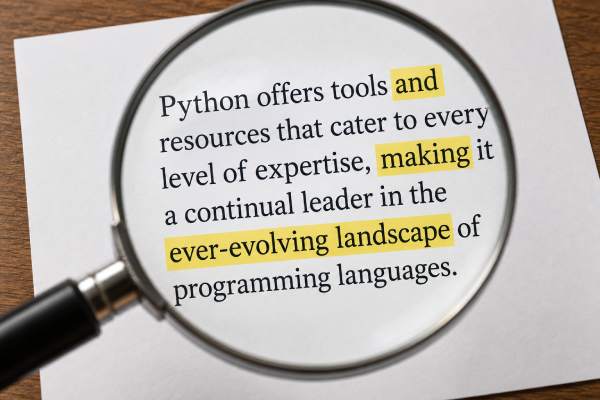
Count the number of times the word "and" appears in a single paragraph - or how many times serial lists (like: A, B, and C) appear. LLMs use "and" to string together multiple observations into long, winding sentences with many examples. While a human might start a new sentence, the machine prefers to continue the current thought with a conjunction - a breathless reading experience.
Pay attention to the transition words at the start of sentences. Robots like formal connectors to connect ideas because they cannot truly "think" through a logical flow. You will see an abundance of these terms.
- Additionally Used to tack on extra information.
- Moreover Used to sound more academic or serious.
- Furthermore Another favorite for extending a list of points.
Look for a high frequency of adjectives ending in "-ing" that describe a broad impact. Words like "ever-evolving" "far-reaching" or "leading" appear constantly in generated drafts. They function as filler to make the writing seem more significant than it actually is.
FAQ
Is it possible to be 100 % sure a text is AI?
No, you can never be entirely certain without watching the person write. Some humans naturally write in a formal, structured way that mimics the patterns of a machine - these tips are indicators, not absolute proof. There are good and honest AI detectors that generate an AI-probability score.
Do all AI models write the same way?
Different models have different "personalities" but they all share the same underlying logic - and flaws. While Claude might sound more conversational than ChatGPT, both still rely on predictable sentence structures and repetitive transition words.
How can I make my own writing look less like AI?
You should vary your sentence lengths and start your sentences with different parts of speech. Get rid of all overly flowery and figurative language. Use specific, concrete nouns instead of vague verbs. Many importantly, remove overused transition words like "Additionally" and "Moreover". Or use a good AI text humanizer that does all of this automatically.
Back to the Blog